AI-Powered Marketing Transformation
You wake up in the morning, sip your coffee, and scroll through social media. The products recommended to you feel as if they’re reading your mind—exactly what you were looking for. The campaigns landing in your inbox appear at just the right moment. Instead of Googling, you now ask ChatGPT. So, what’s really behind all of this?
You wake up in the morning, sip your coffee, and scroll through social media. The products recommended to you feel as if they’re reading your mind—exactly what you were looking for. The campaigns landing in your inbox appear at just the right moment. Instead of Googling, you now ask ChatGPT. So, what’s really behind all of this?
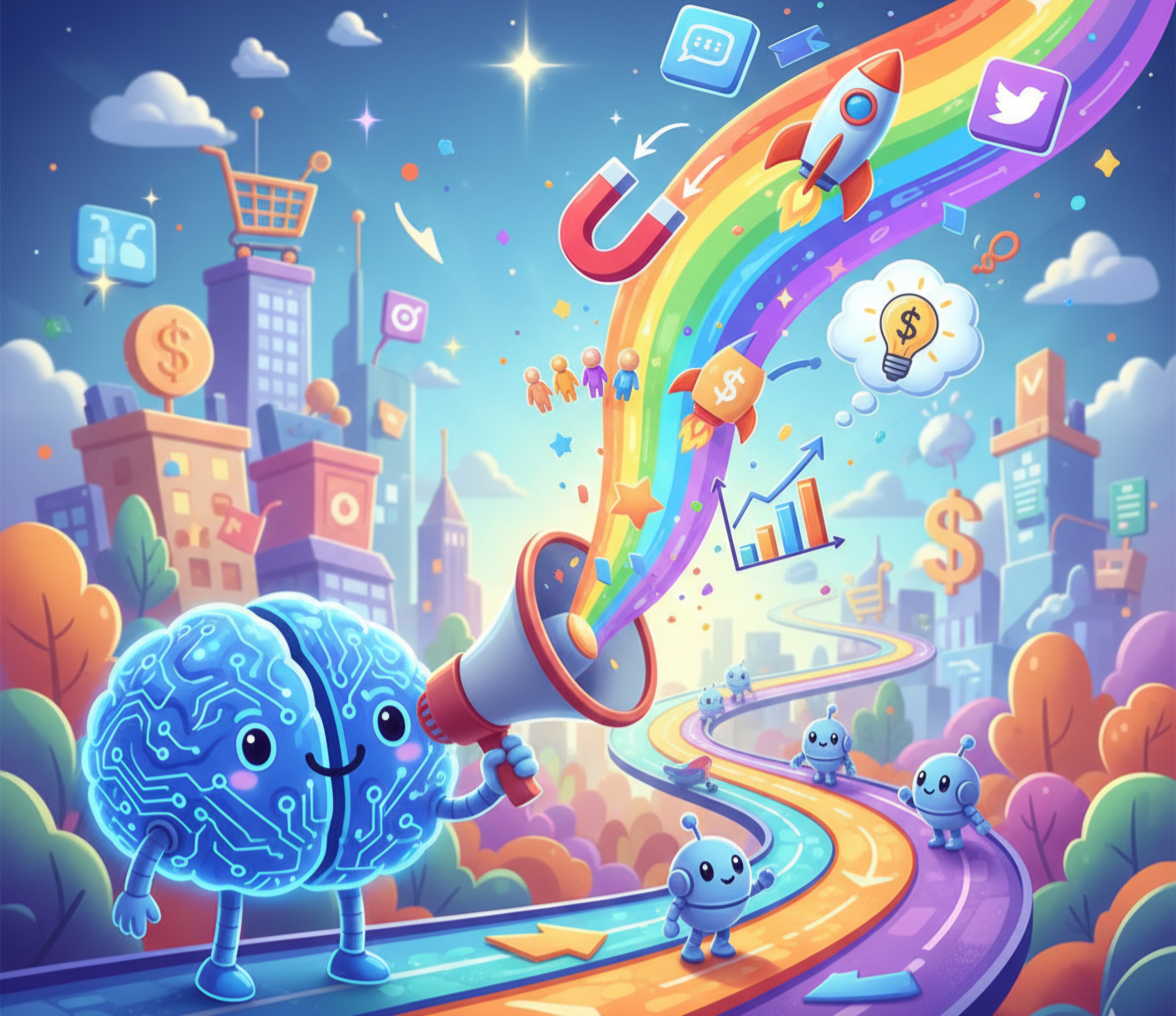
You wake up in the morning, sip your coffee, and scroll through social media. The products recommended to you feel as if they’re reading your mind—exactly what you were looking for. The campaigns landing in your inbox appear at just the right moment. Instead of Googling, you now ask ChatGPT. So, what’s really behind all of this?
The Silent Revolution in the Marketing World
In the past, what we called “personalization” was little more than adding a customer’s name to the beginning of an email. By 2026, artificial intelligence can deliver dynamic visuals tailored to each individual customer, real-time pricing, and personalized video content.
One of the biggest shifts in marketing is how people access information. Google’s 20-year dominance is being seriously challenged. Think about it: when you search on Google, you sift through 10–15 links, reading them one by one. With ChatGPT, you receive a direct, summarized answer—faster, more efficient, and less tiring. This doesn’t mean “SEO is dead,” but it does mean SEO is evolving. Enter a new discipline: GEO – Generative Engine Optimization.
What does this mean for you?
Your content must be optimized not only for search engines, but also for AI models.
When AI tools use your content as a source, your brand should stand out.
Instead of classic “keyword density,” contextual richness becomes critical.
Artificial Intelligence Across 5 Core Areas of Marketing
1. Content Creation
In the past, content was produced by a team, revised, designed, and published. Today, this process has almost turned into a content factory. AI no longer just writes blog posts—it generates ideas, designs visuals, edits videos, adapts copy to brand tone, analyzes SEO compatibility, and predicts which formats will drive higher conversion on which channels. The time spent on a single blog post has dropped from 8 hours to 2.
But beware: AI creates drafts. You must add brand identity, emotional connection, and originality.
2. Ad Optimization
Advertising platforms analyze user behavior, content context, purchase likelihood, and billions of data points to make real-time decisions. As a result, many brands achieve higher conversions at up to 30% lower cost. Google Ads’ Smart Bidding and Meta’s Advantage+ campaigns now require minimal human intervention. The system automatically determines:
When ads should be shown,
Which demographics to prioritize,
How the budget should be allocated,
Which creatives perform best.
You focus on strategic decisions; the rest is automated.
3. Customer Segmentation: A Personalized Experience for Everyone
Broad segments like “women, 25–34, Istanbul” are no longer sufficient. AI evaluates each customer as if they were a segment of one. By analyzing demographic, interest-based, and behavioral data, audiences are broken down into micro-segments—enabling highly customized content and ads.
Example scenario: Two people view the same product. One does so at 10 a.m. from the office, the other at 11 p.m. from home. AI delivers different messages, visuals, and offers to each—and both feel uniquely understood.
4. Customer Service: 24/7 Intelligent Support
Chatbots have moved far beyond the scripted “Hello, how can I help you?” AI-powered customer service systems:
Know the customer’s order history,
Understand the emotional tone of complaints,
Personalize solution suggestions,
Escalate to human agents when necessary.
The result: higher customer satisfaction, lower support costs, and stronger customer loyalty.
5. Video Production: The New Marketing Weapon
Text-to-video tools are reshaping marketing and content creation. Teams no longer wait weeks for campaign visuals. Tools like Midjourney, Sora, and ElevenLabs democratize creative production while increasing speed tenfold.
Automated content creation for platforms like TikTok and YouTube Shorts is becoming standard, while dubbing and lip synchronization for training videos are now much easier.
You write a single piece of text, and AI can automatically generate:
Short videos for social media,
Long-form content for YouTube,
Versions in multiple languages.
All automated.
Important note: For leaders, the critical challenge isn’t using these tools—it’s figuring out how to inject the brand’s “soul” and ethical values into AI-generated outputs.
In Summary: The Future Belongs to “Hybrid” Teams
AI is not a magic wand on its own; when used correctly, it is a powerful lever. Successful brands combine human empathy, strategic depth, and ethical judgment with AI’s millisecond-level processing speed. What once took a week to prepare can now be completed in a single day; A/B tests are optimized autonomously, and complex reports are transformed into strategic insights within seconds.
However, in 2026, marketing transformation is not just about purchasing new software—it’s about building an AI-literate culture that embeds technology into the very core of the business model. As competitors widen the gap with these efficiency gains, failing to integrate AI into workflows becomes not a preference, but a risk. The true competitive advantage lies not with those who merely possess technology, but with hybrid teams that blend technology seamlessly with human creativity.
The Silent Revolution in the Marketing World
In the past, what we called “personalization” was little more than adding a customer’s name to the beginning of an email. By 2026, artificial intelligence can deliver dynamic visuals tailored to each individual customer, real-time pricing, and personalized video content.
One of the biggest shifts in marketing is how people access information. Google’s 20-year dominance is being seriously challenged. Think about it: when you search on Google, you sift through 10–15 links, reading them one by one. With ChatGPT, you receive a direct, summarized answer—faster, more efficient, and less tiring. This doesn’t mean “SEO is dead,” but it does mean SEO is evolving. Enter a new discipline: GEO – Generative Engine Optimization.
What does this mean for you?
Your content must be optimized not only for search engines, but also for AI models.
When AI tools use your content as a source, your brand should stand out.
Instead of classic “keyword density,” contextual richness becomes critical.
Artificial Intelligence Across 5 Core Areas of Marketing
1. Content Creation
In the past, content was produced by a team, revised, designed, and published. Today, this process has almost turned into a content factory. AI no longer just writes blog posts—it generates ideas, designs visuals, edits videos, adapts copy to brand tone, analyzes SEO compatibility, and predicts which formats will drive higher conversion on which channels. The time spent on a single blog post has dropped from 8 hours to 2.
But beware: AI creates drafts. You must add brand identity, emotional connection, and originality.
2. Ad Optimization
Advertising platforms analyze user behavior, content context, purchase likelihood, and billions of data points to make real-time decisions. As a result, many brands achieve higher conversions at up to 30% lower cost. Google Ads’ Smart Bidding and Meta’s Advantage+ campaigns now require minimal human intervention. The system automatically determines:
When ads should be shown,
Which demographics to prioritize,
How the budget should be allocated,
Which creatives perform best.
You focus on strategic decisions; the rest is automated.
3. Customer Segmentation: A Personalized Experience for Everyone
Broad segments like “women, 25–34, Istanbul” are no longer sufficient. AI evaluates each customer as if they were a segment of one. By analyzing demographic, interest-based, and behavioral data, audiences are broken down into micro-segments—enabling highly customized content and ads.
Example scenario: Two people view the same product. One does so at 10 a.m. from the office, the other at 11 p.m. from home. AI delivers different messages, visuals, and offers to each—and both feel uniquely understood.
4. Customer Service: 24/7 Intelligent Support
Chatbots have moved far beyond the scripted “Hello, how can I help you?” AI-powered customer service systems:
Know the customer’s order history,
Understand the emotional tone of complaints,
Personalize solution suggestions,
Escalate to human agents when necessary.
The result: higher customer satisfaction, lower support costs, and stronger customer loyalty.
5. Video Production: The New Marketing Weapon
Text-to-video tools are reshaping marketing and content creation. Teams no longer wait weeks for campaign visuals. Tools like Midjourney, Sora, and ElevenLabs democratize creative production while increasing speed tenfold.
Automated content creation for platforms like TikTok and YouTube Shorts is becoming standard, while dubbing and lip synchronization for training videos are now much easier.
You write a single piece of text, and AI can automatically generate:
Short videos for social media,
Long-form content for YouTube,
Versions in multiple languages.
All automated.
Important note: For leaders, the critical challenge isn’t using these tools—it’s figuring out how to inject the brand’s “soul” and ethical values into AI-generated outputs.
In Summary: The Future Belongs to “Hybrid” Teams
AI is not a magic wand on its own; when used correctly, it is a powerful lever. Successful brands combine human empathy, strategic depth, and ethical judgment with AI’s millisecond-level processing speed. What once took a week to prepare can now be completed in a single day; A/B tests are optimized autonomously, and complex reports are transformed into strategic insights within seconds.
However, in 2026, marketing transformation is not just about purchasing new software—it’s about building an AI-literate culture that embeds technology into the very core of the business model. As competitors widen the gap with these efficiency gains, failing to integrate AI into workflows becomes not a preference, but a risk. The true competitive advantage lies not with those who merely possess technology, but with hybrid teams that blend technology seamlessly with human creativity.